


Why Does the Christmas Tree Star Topper Always Point Up?
- ForestPainting
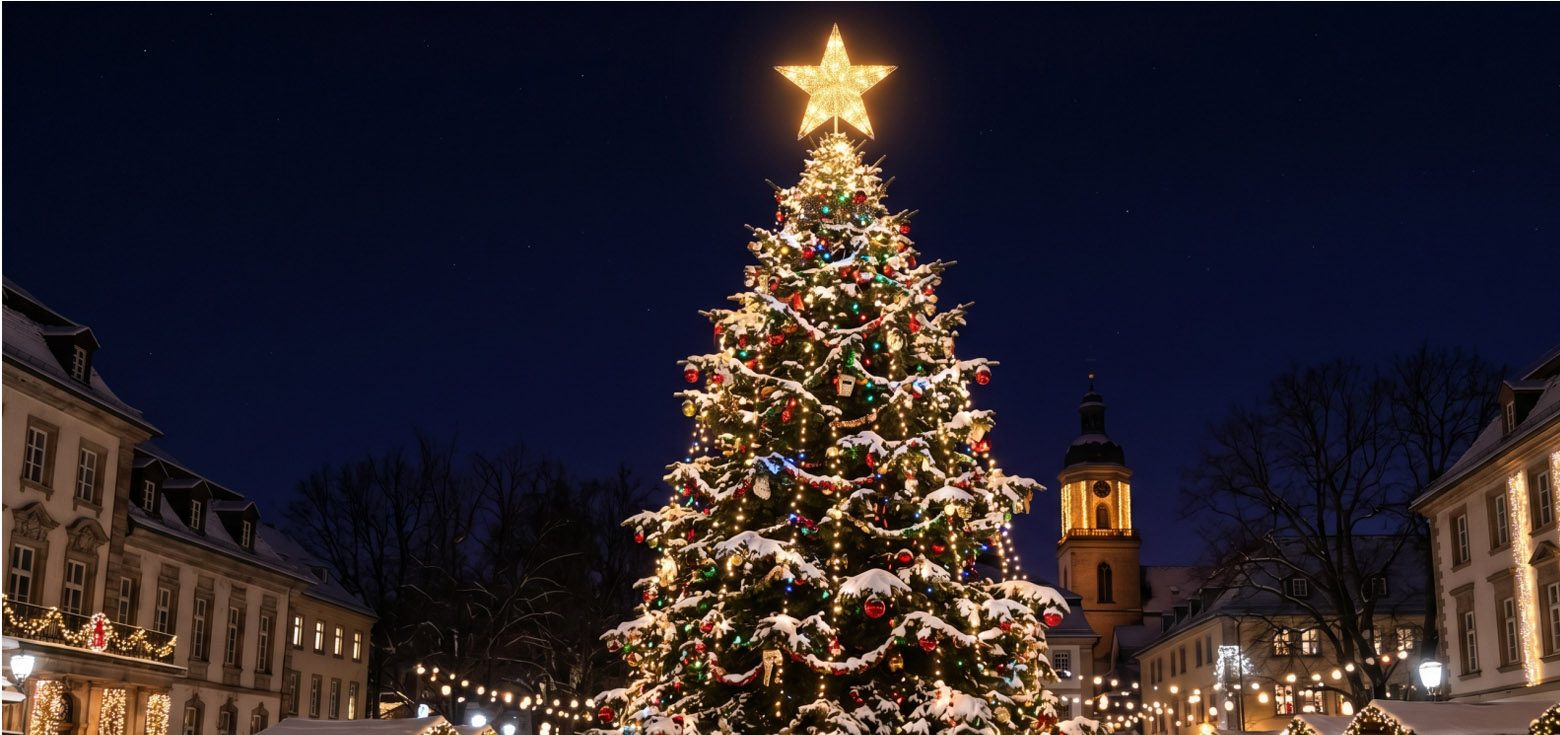
Finding the perfect Christmas tree star topper is the very first thing many people think about when December arrives and trees appear in malls, streets, and homes. Whether the tree is massive or small, luxuriously decorated or completely minimalist, you will always find this common element sitting at the very peak: a five-pointed star with its top point facing straight up.
This star quietly stands at the highest point. Few people ask about its origins, and even fewer wonder “why it has to be a star.” But if you stop to think about it—why not a moon? Why not angel wings? Why not a round glass bulb? Why must it be a star with pointed edges, and why must the top point direct towards the sky?
This article explores the story behind this star: What is its name? Where did it come from? And why must it always point up?
Its True Name: The Star of Bethlehem
If you trace the origins of this familiar ornament, you will find it has a specific name: the Star of Bethlehem.
This name comes from the Gospel of Matthew in the Bible: when Jesus was born, a bright star appeared in the East. Several wise men who studied the stars saw it and followed its path westward, eventually finding the birthplace of Jesus. This two-thousand-year-old story is one of the core plots of the Christmas narrative, profoundly shaping the history of Christmas lighting decorations we study today. In Christian tradition, this star symbolizes divine guidance—in the darkest moments, there is always a beam of light pointing the way for the lost.
In the Catacombs of Priscilla in Rome, dating back to the 2nd century AD, there is a fresco depicting the Nativity scene with a star right above it. This stands as one of the earliest pictorial evidences of how deeply this symbol is rooted in our history.
How Did This Star "Climb" to the Top of the Tree?
Having this name doesn’t mean people put stars on trees right from the beginning. In fact, the Christmas tree itself appeared much later than this story.
It is widely accepted that the modern Christmas tree originated in 16th-century Germany. Devout Christians would bring evergreen trees into their homes and decorate them with apples, nuts, and cookies. So, what was placed at the very top? What was the original Christmas tree topper? Initially, it wasn’t a star at all.
In 16th and 17th century Germany, many families placed a small figure of the baby Jesus at the top. The meaning was direct: Christ is the “light of the world” and rightfully occupies the highest position. By the 18th century, candles began to appear on the trees. The largest candle was usually placed at the top and lit to symbolize the guiding light of the Star of Bethlehem. Compared to a statue, the candlelight indeed looked more like a star. But candles had a major flaw: the fire risk was simply too high. This is also one of the reasons why electric lighting spread so rapidly once it was invented.
When Did the Star Shape Become Mainstream?
The 19th century was a critical turning point.
In 1848, the Illustrated London News published a famous engraving: Queen Victoria, Prince Albert, and their children gathered around a beautifully decorated tree. In the picture, the Christmas tree star topper was nowhere to be seen; instead, an angel sat at the top. This indicates that the popular tree top decoration in British high society at the time was still an angel.
During the same period, German craftsmen began producing glass Christmas ornaments, including various shapes of stars, angels, and baubles. Because German glass ornaments were of high quality and affordable, they were exported in large quantities to the UK and the US, and the star-shaped decorations gradually became widely accepted. By the early 20th century, the five-pointed star had become the most mainstream choice. It was simple, symmetrical, and highly recognizable.
Why Must the Star's Point Face Upwards?
This question is rarely asked, but the answer has three layers.
The first layer: Pointing to heaven. The upward point directs towards the dwelling place of God. In a Christian context, this represents a direction transcending the secular world. An upward-pointing star tells people: look up, hope is there.
The second layer: The symbolism of the pentagram. The five points were later endowed with meaning in Christian tradition—representing the five holy wounds of Jesus. Of course, this explanation is an extension by theologians, not the original source.
The third layer: Visual intuition. Interestingly, modern astronomers suggest the real Star of Bethlehem was likely a planetary conjunction or a comet, meaning it didn’t have any physical “points” at all. However, when humans try to draw a dazzling source of light, we instinctively make one point face upwards. Almost all cultural star symbols are drawn this way. It is a visual instinct and the most perfectly symmetrical choice for craftsmen.
So, are there cases where the star points downwards? Yes. In some modern art designs, designers deliberately invert or place the star horizontally to create visual conflict. But the reason this works is precisely because it breaks the default rule.
Why Put a Star on a Christmas Tree?
Synthesizing the above information, the answer is clear: placing a star on the tree is to commemorate the Star of Bethlehem that guided the biblical Magi to find Jesus. This star symbolizes hope, direction, and divine guidance. Placing it at the highest point of the entire tree implies that its light can illuminate the entire festival.
The Evolution of the Star: From Candles to Large-Scale Lighting
Over the past century, the star at the top of the tree has undergone several massive changes. The materials have shifted from wood and paper to glass and metal, and finally to modern LED lighting.
The size has grown from palm-sized to several meters high—the giant Christmas tree star topper at New York’s Rockefeller Center is about 3 meters in diameter, weighs 408 kilograms, and requires a helicopter to be hoisted into place. Its transformation from pure decoration to an illuminated fixture that can change colors and synchronize with music represents the pinnacle of the evolution of Christmas lighting decorations.
These changes illustrate one thing: when a symbol is important and universal enough, the ways people express it become increasingly diverse.
A 2,000-Year Journey to the Top
Behind a small star lies two thousand years of religious history, five hundred years of evolving customs, and a century of commercialization. It started from the night sky of Bethlehem, traveled through German craft workshops, passed through Victorian living rooms, and finally settled at the top of every Christmas tree.
The next time you look up at that Christmas tree star topper, you might not need to memorize all the historical details, but you can understand one more layer: it points upward to hope, and it shines at the highest point. No matter how the material changes or how the size scales up, the message it conveys remains the same—in the coldest and darkest season of the year, there is always a star to guide your way.
Perhaps this is why, even though we have long known the star is just a decoration, we still persistently, every winter, place that five-pointed star, pointing sharply upwards, firmly at the very top.