When we stand in front of a glowing lantern festival, we are often captivated by the dazzling lights and vibrant colors. However, few people understand the complex Chinese lantern craft hidden behind these brilliant displays. It is not just about putting a light bulb inside a shape; it is a meticulous combination of sculpture, mechanics, painting, and traditional textile arts.
To truly understand the value of these installations, one must explore the broader world of Chinese Lanterns , where history and innovation meet. In this article, we will take you behind the scenes. Using the classic symbol of “Abundance”—the Goldfish—as an example, we will unveil the complete lantern making process, transforming a simple steel wire into a living, breathing piece of art.
Step 1: The Soul of the Design (Drafting)
Every great lantern begins with a 1:1 scale drawing. Unlike modern 3D printing, traditional Chinese lantern making relies heavily on the artisan’s spatial imagination.
For our Goldfish lantern, the artist first draws the detailed outline on the ground. This isn’t just a flat picture; the artist must calculate the curve of the tail and the protrusion of the eyes. This blueprint serves as the foundation for the entire project. In professional lantern making, this step is crucial because even a centimeter of deviation can result in a distorted shape.
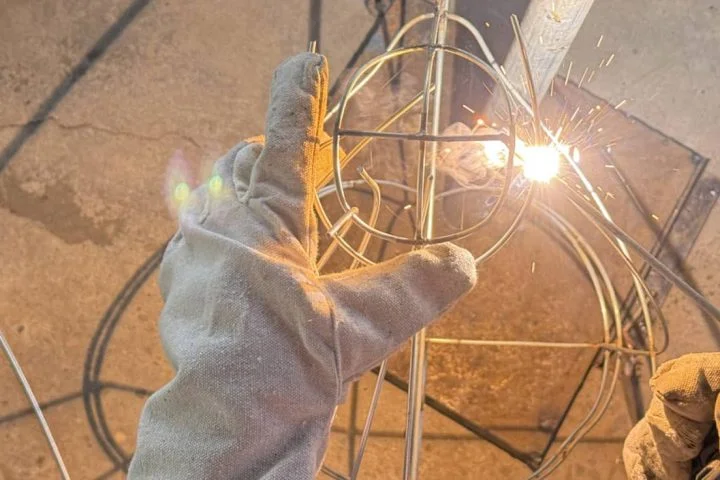
Step 2: Shaping the Bones (Modeling & Welding)
This is where the 2D drawing transforms into a 3D structure. Artisans use steel wires to “flesh out” the drawing. This part of the lantern craft requires significant physical strength and delicate hands.
The welder must be a sculptor, bending cold steel into soft, organic curves that mimic the natural movement of a fish.
Step 3: Installing the "Organs" (Lighting)
Before the “skin” is applied, we must give the lantern its life—light. In the modern lantern making process, we no longer use candles. Instead, waterproof LED strips are carefully installed inside the wireframe.
Step 4: The Art of "Cladding" (Papering)
This step is the most distinct feature of the traditional Chinese Lantern art form. Artisans use a special colored satin or high-density cloth to cover the steel frame.
This is not as simple as wrapping a gift. The fabric must be pulled tight—smooth as skin, with no wrinkles.
Step 5: The Finishing Touch (Artistic Painting)
The final step brings the lantern to life. While the colored cloth provides the base tone, it lacks detail. This is where the painter steps in.
Using an airbrush, the artist adds depth and texture:
In lantern making, this step is known as “Make-up,” ensuring the lantern looks vibrant even from a distance.
Conclusion
From a cold steel wire to a glowing masterpiece, the creation of a Goldfish lantern is a testament to the ingenuity of Chinese lantern craft. It preserves ancient techniques while embracing modern lighting technology.
We hope this guide has given you a deeper appreciation for the lantern making process. Next time you see a Chinese lantern festival, you will know that behind every shimmer of light, there are the hardworking hands of dedicated artisans.