


How a Chinese Lantern Festival Transformed a French Town's Winter Tourism?
- ForestPainting
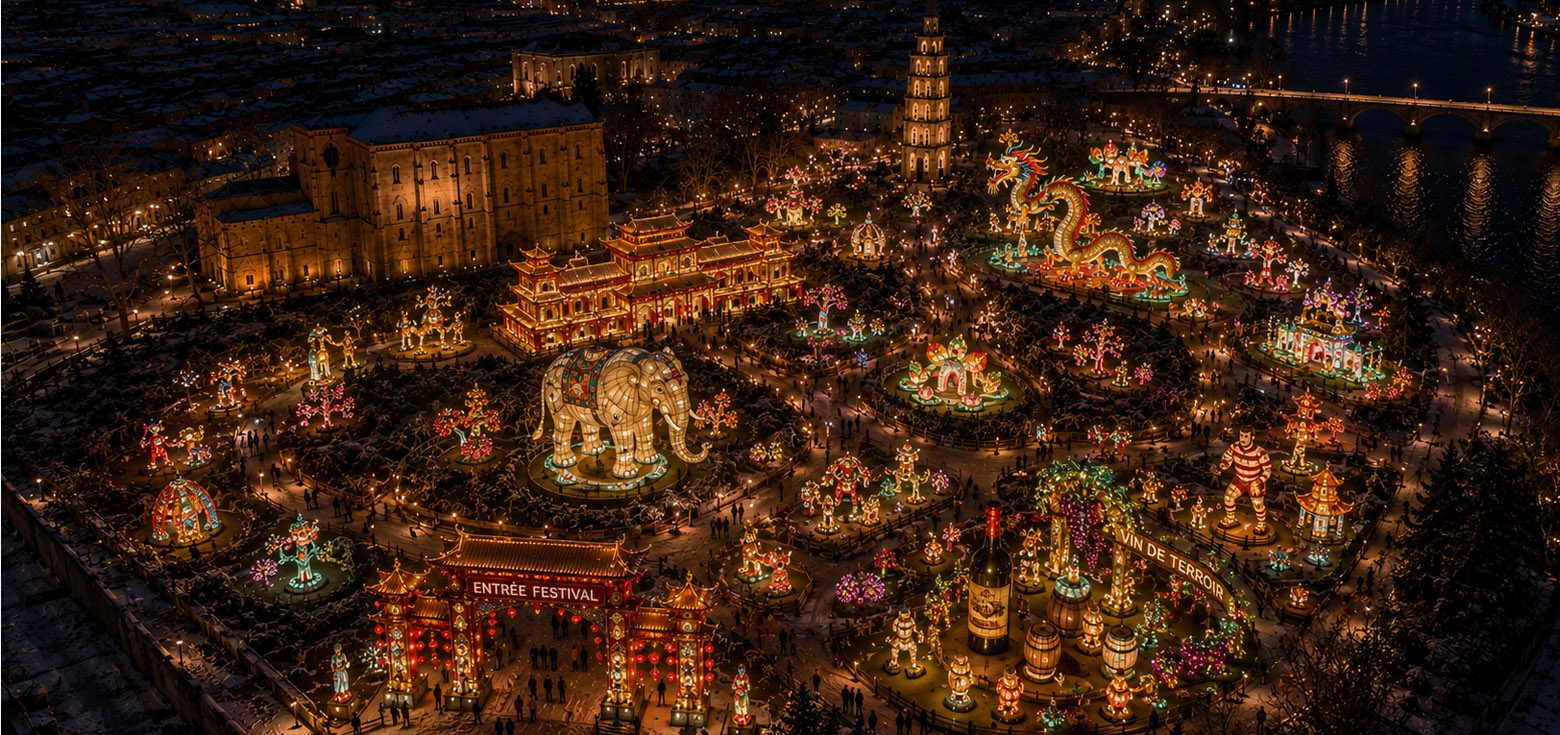
In Europe, the off-season winter slump is a shared dilemma for countless small towns. Searching for an effective winter tourism solution, Gaillac, a small town in southwestern France known for its wine, made a bold decision: introducing a Chinese lantern festival. This winter celebration, born out of the traditional Chinese Lantern Festival, completely changed the town’s destiny. Before this, the ordinary village—lacking ski resorts or famous Christmas markets—saw its streets deserted and shops closed early from November to March. Residents were simply used to the idea that “this is just how winter is.” Its winter was so quiet it was almost forgotten.
But after 2017, things took a dramatic turn.
Every December, illuminated by the moonlight in Gaillac’s park, a 75-meter-long “Forbidden City” slowly lit up, a 20-meter-high giant dragon hovered over the lawn, and dozens of lantern installations dyed the night sky golden red. Tourists flocked from Toulouse, Bordeaux, and even the Spanish border. Town hotels were fully booked, restaurants had lines out the door, and even local bakeries had to work overtime to bake enough bread.
It all started with what locals called a “mad” gamble.
"The Whole Town Thought I Was Crazy"
In early 2017, then-Mayor Patrice Gausserand visited Zigong, China. One night, he saw Zigong lanterns for the first time—giant dragons, palaces, and mythological figures crafted from silk and steel, looking completely magical in the dark. As he later recalled to AFP, only one thought crossed his mind:
“If we bring this to Gaillac, would winter be different?“
Upon returning to France, he pitched the idea to his municipal team and the local chamber of commerce.
Almost everyone shook their heads. “It’s too expensive.” “Who would travel in the dead of winter to see Chinese lanterns?” “We have our own Christmas markets, why do we need this?“
Gausserand later admitted to AFP that the word he heard most during those months was “folie“—madness. What made it even more daunting was the financial reality: the budget for the first festival was nearly 800,000 euros. For a town of fewer than 20,000 people, this was undoubtedly a massive gamble. He spent months searching for private sponsorships, hitting wall after wall, until the owner of a local supermarket (E.Leclerc) finally agreed to support the initiative.
Beyond funding, there was an unimaginable logistical chasm. Hundreds of tons of steel, massive amounts of silk, and tens of thousands of LED bulbs had to be precisely packed into dozens of standard shipping containers, traveling across the ocean from inland Sichuan, China, to southwestern France. The budget was so tight they couldn’t even afford a professional transnational coordination team—eventually, a Chinese language teacher from a local high school volunteered as a translator. Gausserand flew back to Zigong himself, gesturing and explaining to the craftsmen where this obscure French town was on the map, begging them to make the overseas trip.
But he didn’t give up.
On December 1, 2017, the inaugural Chinese lantern festival opened in a park on the outskirts of town. Thirteen craftsmen from Zigong spent a month constructing a seven-hectare large-scale light exhibition, featuring 35 sets of exquisite custom lanterns.
On opening night, standing at the entrance, Gausserand had no idea what to expect.
250,000 Visitors, 1 Million Euros
When the numbers came in, the entire southwest of France was stunned.
In just two months, the first festival attracted 250,000 visitors—about 14 times the population of Gaillac (approx. 18,000). Ticket sales brought in 1 million euros for the local economy, which the mayor described as a “windfall.” Visitors traveled from Toulouse, Bordeaux, Montpellier, and even across the Spanish border.
Local businesses were the first to feel the impact. One restaurant owner told French media that in previous winters, his establishment was only open three days a week, sometimes serving only two or three tables a night. During the festival, “we opened every day and had to hire part-time help.” The local villa rental association reported to AFP that winter bookings over the past two years had doubled. A bar owner noted that his turnover during the festival was three times higher than the same period in previous years, forcing him to call staff back from vacation.
90-year-old Simone arrived in a wheelchair, driven over an hour from Toulouse by her grandson. She paused in front of the 75-meter-long “Forbidden City” lantern set, took out her phone, and filmed for a long time. When an AFP reporter asked her why she was filming, she replied:
“I want to show my grandchildren all the wonders from another world.“
That quote was later reprinted by multiple media outlets, becoming the most touching footnote of the Gaillac Lantern Festival.
When Craftsmen Become Part of the Town
Between October and December every year, around 80 lantern craftsmen from Zigong would arrive in Gaillac. They pitched tents in the park, welding steel frames and applying silk during the day, and adjusting lighting at night. During tight deadlines, they worked from 8 AM to 10 PM.
At first, the townspeople just watched from a distance. Later, some started bringing coffee and bread. Eventually, several retired electricians volunteered to help run cables.
“They are the most welcome people. You’d see Chinese craftsmen and French grandpas communicating with hand gestures. It was like a chicken talking to a duck, but in the end, they always understood each other.” — A local volunteer to French media.
This cross-cultural collaboration was later called “the festival’s most precious legacy” by Gausserand. He told AFP: “This festival has created strong bonds between the town staff, volunteers, and the roughly 80 Chinese workers who come to Gaillac for two months.“

From Skepticism to Participation
By the second year, a subtle shift occurred. By December 15, ticket sales were already three times higher than the same period in 2017. The number of Chinese craftsmen increased from 13 to about 80, and the scale of the installations expanded.
More importantly, the attitude of the locals changed. In the first year, many felt “this is the mayor forcing a foreign project on us.” But when residents walked into the park, they saw not only unfamiliar Eastern dragons but also French rugby players and crystal-clear Gaillac grapevines, all crafted using Zigong’s intangible cultural heritage techniques. The Chinese artisans used the most traditional Eastern craftsmanship to pay tribute to the local pride of southwestern France.
This clever “localization” completely dissolved cultural barriers. By the second year, red lanterns and dragon decorations spontaneously appeared in shop windows, barbershops, bars, and on residents’ balconies. As an AFP report described: “At a time of year when most French shops are decked in Christmas decorations, shop windows, hairdressers, bars, and residents’ balconies here are hung with red lanterns and dragons.” Gausserand noted in an interview: “Now, this is everyone’s festival.“
For the third edition, ticket sales surged from 210,000 in 2017 to 480,000, bringing the three-year total to over 1 million visitors. Gaillac and Zigong officially signed a sister-city agreement. The local high school’s Chinese language class expanded from a dozen students to the entire grade.
From Gaillac to a Touring Super Tourism IP
After three consecutive years, Gaillac’s hosting capacity reached its absolute limit. With an average of 2,000 daily visitors on weekdays and over 10,000 on weekends, the town’s traffic system was paralyzed. Hotels were entirely sold out. An event initially designed to save winter tourism had exceeded the city’s physical carrying capacity.
To transform a one-time “miracle” into a sustainable tourism asset, it had to be supported by more robust urban infrastructure. Consequently, the festival was logically relocated to Blagnac, a core city near Toulouse with an international airport. But this was not the end. This Chinese lantern festival has since grown into a “touring super tourism IP” fiercely sought after by major French cities.
After breaking attendance records in Blagnac, it was invited to Montauban from 2022 to 2024. For the latest 2025-2026 winter season, it upgraded once again, landing at the Château de Castel Novel in the Corrèze department as a breathtaking large-scale light exhibition. From a small town’s “gamble” to a nationwide touring winter cash cow, Chinese lanterns achieved this in under five years.
A Broader Vision: 92% Global Market Share
The story of Gaillac is not an isolated one. According to public reports from Xinhua News Agency:
The Zigong lantern industry chain has an annual output value exceeding 6 billion RMB.
The industry employs 100,000 people.
It commands 85% of the domestic market and 92% of the international market.
In 2025, Zigong enterprises successfully executed 112 large-scale light exhibition projects across 85 cities in 19 countries.
In March 2025, the Zigong Lantern Group signed a long-term cooperation agreement with GL events in France, officially transitioning the Chinese lantern festival overseas from “one-off exhibitions” to sustainable annual operations.
From Houston, USA, to Chinatown in Singapore, and further to Kuwait and the UAE, Chinese lanterns have become a formidable product in the international winter tourism market.
Three Key Takeaways
The Gaillac case offers three valuable business and cultural insights for any destination facing a winter tourism slump:
1.The Way Out of the Off-Season is Creating a "Must-Visit Reason"
Gaillac has no ski resorts and no hot springs. Its solution was to introduce a cultural product entirely foreign to the local area. The key: the product must be inherently viral. A 75-meter-long imperial palace and a 20-meter-high dragon are naturally perfect for photography and social media sharing. Tourists didn’t come “to visit Gaillac”; they came “to see the lights.”
2.Cross-Cultural Projects Must Be Localized
A pure exhibition of “Chinese symbols,” even if it authentically replicates the traditions and customs of the Chinese Lantern Festival, will struggle to resonate deeply in a foreign land. The Chinese and French teams spend two months working together every year, specifically integrating southwestern French wine themes and rugby elements to ensure the lantern designs preserve Eastern craftsmanship while fitting the local cultural context.
3.Sustainable Operation Beats a One-Time Buzz
Gaillac hosted the event for three consecutive years, accumulating reputation, cross-border logistics capabilities, and cross-cultural collaboration experience, which eventually allowed the model to expand nationwide. Pop-up events can generate quick revenue, but they cannot settle into a city’s brand asset. Three years is the minimum time required for a festival to transition from an “event” to a “tradition.”
Gaillac's Winter
Today, the lantern festival has moved on, continuing its touring journey. But winter in Gaillac has not reverted to the past.
Not because the lights are still on—the lights are gone. It’s because the people here learned something over those three years: winter doesn’t have to just be endured. Those chamber of commerce members who once shook their heads now proactively tell out-of-town buyers “the story of how we brought dozens of shipping containers of Chinese lanterns over.” The old lady running the bakery still habitually stocks extra flour every December. And the high school Chinese class remains expanded to the entire grade.
Gausserand is still occasionally recognized.
“Are you that ‘crazy’ mayor?“
“Yes,” he smiles, “I’m that madman.”
References:
[1] France 3 Occitanie. (2021). Gaillac et le festival des Lanternes : fin de l’histoire dans le Tarn
[2] La Dépêche du Midi. (2020, February 2). Gaillac. Le Festival des lanternes, c’est fini !
[3] Franceinfo. (2017, December 1). Tarn : inauguration du festival des lanternes à Gaillac.
[4] AFP / Oman Observer. (2018, December 28). Let it glow, let it glow!
Disclaimer:This article is a business case observation within the cultural tourism industry. Data and historical developments regarding the French lantern festivals are intended to objectively analyze the lifecycle, IP expansion logic, and localized operation models of transnational tourism projects for industry reference. Narratives regarding early local administrative decisions and related figures are provided solely for background context and do not constitute an endorsement or evaluation of any specific political stance, local public affairs, or subsequent derivative controversies.