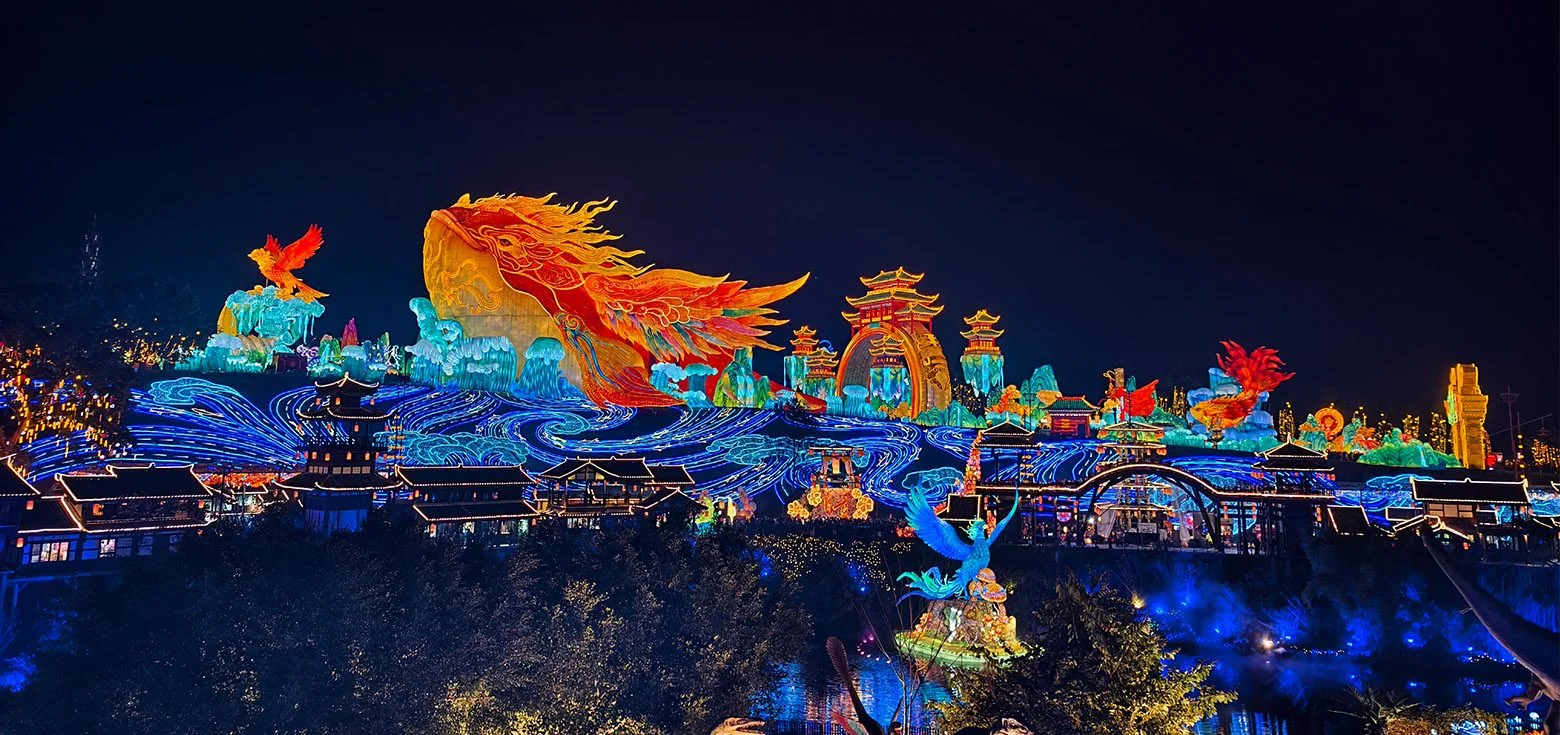
When Chinese New Year lantern symbols illuminate the long, freezing winter nights, you are witnessing much more than a seasonal decoration; you are reading a universal language of hope. Long before modern electricity flooded our streets, humanity instinctually sought light to dispel the darkness and psychological gloom of the coldest months. To truly understand the history of Chinese New Year lanterns, we must look beyond their vibrant colors and massive steel frames. We must read them as a profound visual story—a testament to human resilience, an ode to agricultural reverence, and a brilliant canvas reflecting the simple desire for a good life.
By taking the time to decode these ten iconic figures, we uncover the true meaning of Chinese New Year lanterns and discover exactly why they continue to captivate the hearts of people across the globe.
The Meaning of Chinese New Year Lanterns
To grasp the aesthetic power of these giant installations, one must first look back at their humble, ancient origins. Historically, the earliest forms of lanterns were deeply rooted in ancient fire worship, where people lit torches to ward off wild beasts and unseen evil spirits lurking in the dark.
Today, the true meaning of Chinese New Year lanterns acts as a beautiful rebellion against winter. The light of the lantern is designed to dispel the winter chill, symbolizing the illumination of the path ahead for the New Year. It represents an eternal, deeply human hope for family reunion and good fortune. When a city or a home puts up these glowing Chinese New Year lantern symbols, they are essentially staging a rebellion against the harshness of winter, temporarily transforming a frozen landscape into a warm, sacred space of celebration and renewal.
Zodiac Lanterns and Mythical Guardians
The most striking and universally beloved elements in any festive display are the dynamic creature totems. In traditional Chinese lantern designs, these creatures are never just animals. They are gentle guardians, cosmic messengers, and storytellers of time.
1. The Zodiac Cycle
Chinese zodiac lanterns are a unique New Year symbol that embodies the core theme of bidding farewell to the old year and welcoming the new. Western cultures often view time as a straight, linear arrow, constantly moving away from the past. The Eastern tradition, however, sees time as a comforting, natural circle. By assigning an animal to each year in a 12-year cycle, time becomes something alive and cyclical.
For example, as the zodiac for 2026 is the Horse, festival-goers will be greeted by towering Chinese zodiac lanterns shaped like galloping steeds. In an agrarian society, the horse is a creature of immense vitality and forward momentum. After the stagnation of winter, a glowing horse lantern serves as a psychological trigger, urging people to gallop into the new year with unstoppable energy. These giant lanterns act as glowing milestones, reminding us that no matter how hard the previous year was, a new beginning is always on the horizon.
2. The Eastern Dragon
In Western mythology, dragons are frequently depicted as fire-breathing monsters hoarding gold in caves—beasts that brave knights must slay. The Eastern dragon, however, represents the exact opposite. As one of the most powerful Chinese New Year lantern symbols, it is a supreme symbol of power and auspiciousness. Fundamentally, it is a creature of water, not fire.
To understand the dragon lantern, you must put yourself in the shoes of an ancient farmer. Their entire survival depended on the unpredictable arrival of spring rains. When they looked up at the clouds, they imagined a majestic, serpentine guardian controlling the weather. A massive dragon lantern, winding its illuminated body through a festival plaza, isn’t meant to terrify; it is a giant, communal prayer. It is a visual plea to the heavens for favorable weather, a bountiful harvest, and the benevolent protection of the community.
3. The Phoenix
If the dragon represents the life-giving force of water and the sky, the phoenix is its perfect counterpart in traditional Chinese lantern designs, representing good omen and ultimate harmony. Legend states that this magnificent bird is incredibly elusive, choosing to reveal itself only in times of great peace, prosperity, and righteous leadership.
In the chaotic and often unpredictable world we live in, the phoenix lantern holds immense emotional weight. When artisans blend vibrant silks to create its sprawling, glowing tail feathers, they are constructing a visual sanctuary. To stand beneath a towering phoenix lantern is to share in a collective, silent hope: that the coming year will be free of turmoil, and that grace and stability will reign supreme.
4. The Qilin
The Qilin (often called the Chinese Unicorn) might look intimidating at first glance. Featuring a dragon’s head, the antlers of a deer, the scales of a fish, and the tail of an ox, it appears ready for battle. Yet, it holds one of the most beautiful secrets in Eastern mythology: it is the ultimate symbol of gentleness and compassion.
Ancient myths claim that the Qilin possesses unimaginable power, yet it steps so softly and carefully that it refuses to crush a single blade of grass or harm a wandering insect. A Qilin lantern radiates this profound paradox. It teaches viewers a timeless lesson about character: true strength is not about destruction or dominance, but about having immense power and choosing to be unconditionally kind.
5. The Koi Fish
The fish is heavily favored for its clever wordplay, taking advantage of the pun of “fish” (yú) and “surplus” (yú). A glowing fish lantern is the most direct visual prayer for an abundant life—meaning “abundance year after year”. But its popularity in traditional Chinese lantern designs goes much deeper than a linguistic trick.
The koi fish represents one of the most beloved underdog stories in Chinese folklore. Legend says that any carp that can swim against the fierce, rushing currents of the Yellow River and leap over the mythical Dragon Gate will instantly transform into a powerful dragon. Lantern artists frequently freeze this magical moment of transformation in light. When parents walk their children past a glowing fish lantern, they aren’t just wishing for wealth; they are passing down a story of resilience, teaching them that sheer perseverance can help anyone overcome the currents of life.
Traditional Flora and Artifact Designs
Beyond the mythical beasts, the art of Chinese New Year lanterns deeply embraces static elements from nature and daily life. These traditional Chinese lantern designs ground the ethereal festival in the earthy, honest hopes of everyday people.
6. The Peony
Regarded as the “King of Flowers,” the peony has long symbolized prosperity and good fortune. But its true emotional impact as a staple among Chinese New Year lantern symbols lies in its timing. The Lunar New Year takes place in the dead of winter, when the world outside is often barren, gray, and devoid of life.
To construct a colossal, brilliantly lit peony in the middle of a frozen park is an act of sheer psychological defiance. It is a promise made of light and silk. When people gather around its glowing, layered petals, they are reminded that no matter how long and bitter the winter has been, the vibrant, colorful, and warm days of spring will inevitably return.
7. Peach Blossoms
The earliest forms of New Year door decorations, which eventually evolved into modern paper couplets, originated from carved peach wood talismans. Why the peach tree? In the natural world, peach blossoms are among the very first flowers to bravely bloom through the late winter frost.
Ancient people observed this incredible, stubborn vitality and believed the tree possessed a pure, natural energy strong enough to terrify the demons of winter sickness and bad luck. Today, when festivals erect glowing corridors of peach blossom branches, they are creating a luminous, protective shield. Walking through this soft pink light is a symbolic shedding of the past year’s ailments, a visual cleanse for the soul.
8. Kumquats & Persimmons
These fruits are cherished purely for their optimistic sounds, proving that language can shape reality. In Chinese, “kumquat” sounds almost identical to the word for “luck,” and “persimmon” sounds like “matters” or “affairs.”
Human beings have always used positive affirmations to soothe anxiety about the future. By crafting giant, glowing golden orbs that represent these fruits, the culture is essentially surrounding itself with physical, illuminated affirmations. They tell a simple, heartfelt story: may every single matter you encounter this year be as lucky, sweet, and bright as the light shining before you.
9. The Ingot
Not all symbols are deeply philosophical; many embrace the pragmatic, everyday realities of life. Ingot lanterns directly express the desire to welcome wealth and good fortune. Shaped like ancient, curved boats with a raised center, these golden structures are incredibly common in lantern festivals.
Rather than viewing this as mere greed, it is important to see it as a celebration of honest labor. It shows a culture that isn’t shy or guilty about wanting a better life. It is an honest, unapologetic wish that a year of hard work in the fields or the city will pay off, ensuring that the family remains fed, comfortable, and secure.
10. The Gourd
The gourd has a fascinating and comforting backstory. In ancient folk tales, dried gourds were the signature bottles used by wandering healers and immortals to carry powerful, life-saving medicines. Because of this association, the gourd became a symbol of healing and protection against disease.
Hanging a glowing gourd lantern during the New Year acts as a visual comfort in cold times. It is thought of as a magical, cosmic sponge. The belief is that its wide bottom absorbs the sickness, bad luck, and negative energy of the old year, trapping it inside. In return, it pours out nothing but health, safety, and purity for the days to come.
Conclusion: A Universal Language of Light
The true magic of these illuminated installations lies not just in their staggering scale or intricate craftsmanship, but in their deep humanity. On the surface, they are breathtaking examples of traditional Chinese lantern designs, showcasing centuries of artistic heritage.
Yet, to fully grasp the meaning of Chinese New Year lanterns, we must see them as vessels for emotions we all share. They are built to hold our collective prayers for the days ahead, temporarily transforming a frozen landscape into a warm sanctuary of celebration.
Ultimately, these Chinese New Year lantern symbols remind us of a profound truth. No matter our cultural background, the instinct to seek light in the dark, the love for our families, and the hope for a healthy, prosperous future belong to humanity as a whole.