


How to Make Shopping Mall Christmas Decorations Go Viral on Social Media?
- ForestPainting

Every December, shopping mall Christmas decorations across major commercial centers look largely the same. Shoppers walk by, occasionally glance up, and keep their heads down. Yet, there are always some decorations that make people drive an hour specifically to see them, queue for 30 minutes to take photos, and spontaneously flood Instagram, TikTok, and Facebook.
What’s the difference? It’s not the budget—many setups that cost a fortune still go unnoticed. As many holiday lighting guides point out, the real difference lies in this: is your design “made for on-site viewing” or “made for screen sharing”?
Five Proven Design Principles
Based on visual psychology and social media sharing research, we found that custom Christmas displays capable of triggering massive spontaneous sharing on social platforms almost always possess at least three of the following five characteristics.
1. Provide an "Anti-Intuitive" Viewing Angle
The human eye is accustomed to eye-level, standard proportions, and normal perspectives. When a decoration shatters these expectations—such as being absurdly large, hanging upside down, or using mirrors to create an illusion of infinite extension—the brain instantly gets excited.
This “anomaly” is amplified on a smartphone screen. The impulse to screenshot, snap a photo, and share often stems from the sheer amazement of “I can’t believe this is possible.” If a photo makes people immediately ask, “How did they do that?”, its probability of being shared multiplies.
From a psychological standpoint, “amazement” is one of the strongest motivations for sharing. When someone sees something that exceeds expectations, they instinctively want to tell others. This isn’t corporate marketing; it’s human instinct.
The test: Show a photo of the decoration to someone who hasn’t been to the site. If their first reaction is “Is this real?” or “How was this made?”, the design works.


2. Let Customers "Step Into" the Scene, Not Just Stand Outside
The best decorations aren’t just for “looking at”; they are for “entering.”
When people can crawl into, walk through, or sit on something, they are no longer bystanders but part of the picture. Photos featuring people are much more likely to generate likes and comments than pure landscape shots, because viewers naturally imagine, “What if I were standing there?”
A giant sphere you can walk into, a light-covered tunnel, or an immersive holiday display you can sit on—these scenes naturally invite participation. Once a person “enters” the decoration, the photo is no longer “Look at what is here,” but “Look at me being here.” The desire to share the latter is far higher than the former.
Data from mainstream social platforms reveals that images featuring faces or human figures have an average engagement rate about 40% higher than pure scenery images (based on public Meta ad performance data). People prefer sharing “their own moments” rather than merely the scene setup itself.
The signal: If you see customers handing their phones to friends, asking them to take a photo of them, the design is already halfway to success.

3. Create "Exclusively Mine" Interactive Moments
Interaction doesn’t necessarily require high-tech features. But the most effective interactive Christmas installations must make participants feel, “I caused this effect.”
For example, lights that change intensity with sound, touching different objects to trigger different colors, or a person’s shadow being projected as a Christmas silhouette. The commonality of these interactions is that the visual each person gets is completely unique. It’s not the mall’s promotional photo; it’s “my own creation.”
This “sense of causality” sparks a strong desire to share. Because people aren’t just sharing a beautiful scene; they are sharing “I made this happen.” This is a form of self-presentation, and its social value far outweighs simply forwarding official shopping mall Christmas decorations images.
From motivational psychology, sharing “one’s own creation” satisfies the need for self-efficacy—the need to prove “I have the ability to influence the world.” The moment a button is pressed and the lights turn on is the exact moment this need is met.
The mechanism: A simple interaction (like standing in a specific spot so your shadow forms angel wings) is enough to make someone say, “Look, I did this.” That sentence is the starting point of sharing.
4. Optimize for the Smartphone Screen, Not the Naked Eye
This dimension is the easiest to overlook, but it might be the most important.
Smartphone screens are small, and fine details might blur, but colors and light/shadow contrasts are heavily magnified. That is why monochromatic decorations (all white, all blue, all gold) often look more “premium” in photos than multi-colored ones; as principles of lighting optics explains, the soft glow from materials like silk, frosted glass, and paper art is far more photogenic than the harsh, direct glare of exposed LEDs.
Another frequently ignored factor is the flickering of LED strings. Many flickers that are invisible to the naked eye turn into obvious ripples or banding under a smartphone camera, rendering the photo unusable. This isn’t “bad luck”; it’s a failure to account for photography needs during the design phase.
Furthermore, high-contrast lighting (extreme brightness + deep shadows) easily causes overexposure or crushed blacks in mobile photos, whereas soft, even, diffused lighting preserves more details. Material selection directly dictates the viral potential.
The check: Take a photo of the decoration with a smartphone and zoom in. If you see banding, ripples, or large areas of pitch black, the setup is not suited for social media propagation.

5. Give Customers a "Copy-Worthy" Caption
When people share photos, they always need to write something.
If your decoration allows them to effortlessly type out a sentence—”I crawled inside that giant Christmas bauble!” “Guess how this Santa Claus is flying?” “I stood under that tree for three minutes, and it kept changing colors.”—that sentence alone is worth half the viral power.
Excellent custom Christmas displays come with built-in stories. They require no explanation; one glance is enough to describe it in a single sentence. And this description becomes the reason others want to try it out too. When a potential customer sees a friend post, “I walked inside that sphere,” they will think, “I want to do that too.”
This is the power of “social proof.” It’s not the merchant’s ad saying “This is fun,” but your friend saying “I tried it, and it’s fun.”
The test: Stand in front of the site and pretend you are about to post a photo. What’s the first sentence that pops into your head? If it’s just “Merry Christmas” or no text at all, the scene hasn’t provided a story.
Why Do Most Shopping Mall Christmas Decorations Fail at This?
It’s not for a lack of money.
Many malls spend top dollar, only to buy standard catalog items: Christmas trees, string lights, and Santa models. There is nothing inherently wrong with these products—their ability to create an atmosphere is stable. But they are designed for the “site,” not for the “screen.”
The scenes that go viral on social media are almost never off-the-shelf catalog products. They are custom Christmas displays specifically tailored to the venue, audience, and sharing objectives. The difference between the two isn’t the size of the budget, but the design goal: the former aims for a “festive atmosphere,” while the latter aims to “make people want to snap, post, and talk.”
Factors to consider in custom design include: Is the photo angle “anti-intuitive” enough? Is there space for people to step inside? Are there controllable interactive mechanisms? How does it look on a smartphone screen? Does it prompt people to naturally utter a caption? Standard catalogs simply don’t answer these questions.
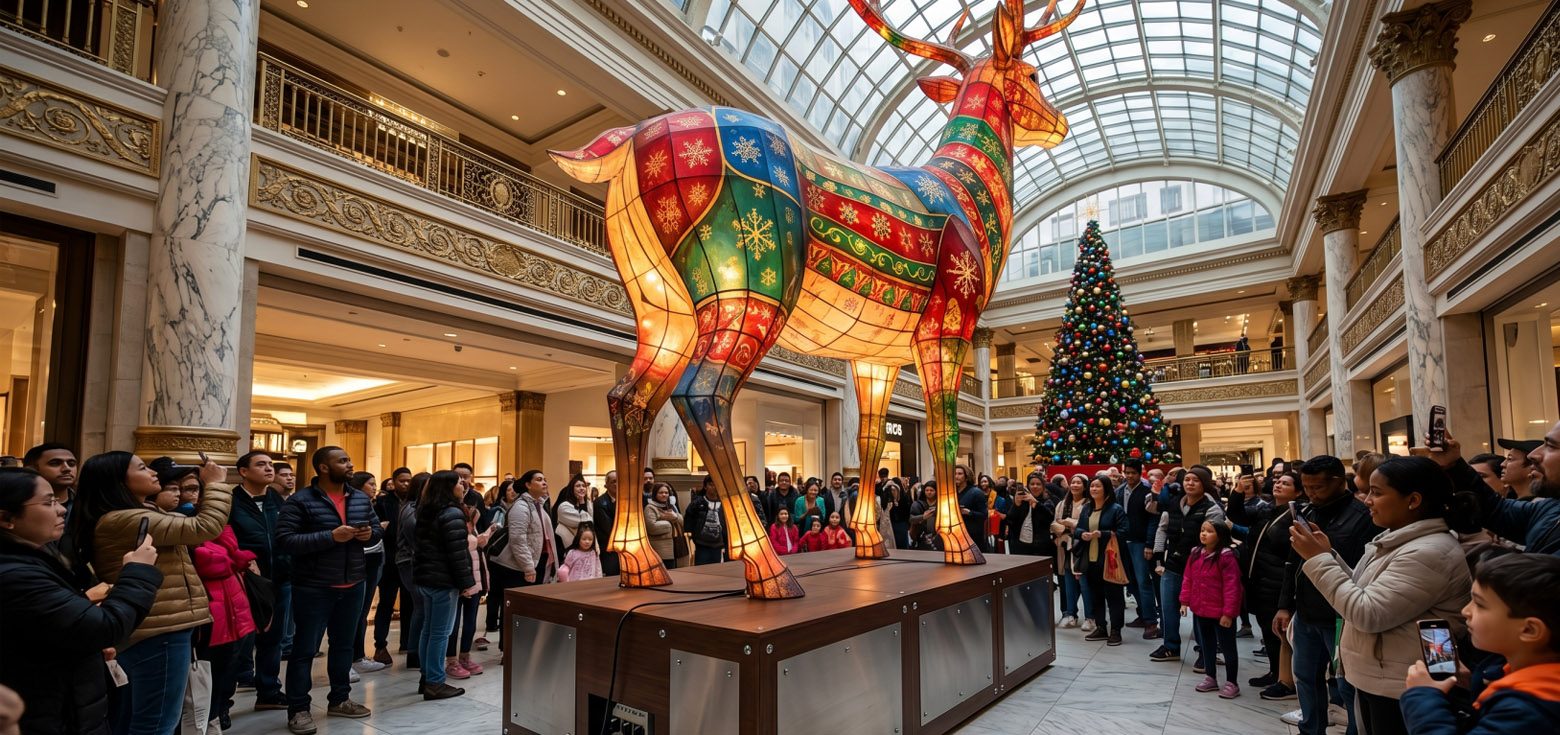
A Simple Decision Framework
Before you finalize this year’s immersive holiday display plan, ask yourself four questions:
Will its size or angle make people go “Wow”?
Can people walk into the picture, or can they only stand outside looking in?
Can customers use the interactive Christmas installation to create an “exclusively mine” effect?
If taken as a photo, what would the caption be?
If all four answers are unclear, then no matter how much money is spent, it likely won’t spread on social media.
Let Good Design Become Your Free Marketing Channel
Social media virality isn’t luck; it’s the result of design. The scenes that go viral are backed by a precise grasp of human attention, sharing motivations, and mobile photography traits.
Your customers don’t not want to share. They just need a photo worth taking, a scene they can step into, and a story they can tell. Give them these, and they will naturally become your distribution channels.