


How Three Different Nations Celebrate the Mid-Autumn Festival in Asia?
- ForestPainting

When exploring the true nature of the Mid-Autumn Festival in Asia, it becomes evident that this celebration is far from a homogeneous cultural monolith. Western audiences and international event planners often generalized these autumn festivities under the broad umbrella of the Asian Moon Festival, assuming that the entire continent follows a boilerplate formula of eating pastries and gazing at the moon. In reality, beneath this shared full moon, different nations have evolved entirely distinct social functions, visual languages, and psychological coping mechanisms based on their own historical paths.
In China, the cultural symbolism behind Mid-Autumn lanterns serves as the central visual anchor, utilizing grand, warm artificial light to dispel the autumn chill and celebrate the secular reunion of the living family. However, once boundaries are crossed, a completely different civilizational narrative unfolds under the exact same night sky.
Core Differences Matrix of Pan-Asian Moon Festivals
Country | Focus of Celebration | Iconic Visual Element | Core Social Behavior |
China | The entire living family | Massive steel-frame silk lanterns | Cross-city reunions, nighttime lantern festivals |
South Korea | Departed ancestors and lineage | Quiet spaces adorned with traditional paper lamps | National mass migration, morning Charye rituals |
Vietnam | Children and the next generation | Streets filled with handmade star-shaped lanterns | Street drum performances, massive youth parades |
The Diverse Cultural Map of Asian Moon Festivals
From a historical perspective, most autumn celebrations across East and Southeast Asia can be traced back to ancient agricultural rituals thanking the land for the harvest. However, over centuries of geopolitical shifts, religious integration, and evolving family structures, the exact same fifteenth day of the eighth lunar month has cultivated completely distinct collective psychologies in different nations. This cultural diversity not only enriches the pan-Asian festive landscape but also demands a higher level of nuance from modern cross-cultural event planners—understanding these deep distinctions is the first step toward avoiding cultural appropriation and achieving precise thematic expression.

China's Mid-Autumn: Hyperscale Silk Lanterns and Reunion
In the foundational cultural narrative of China, the fifteenth day of the eighth lunar month is a grand family gathering focused intensely on secular reunion.
Distinct from the celebratory axes of other Asian nations, China’s festival is strictly a nighttime event. Driven by the primal desire to confirm the completeness of the family lineage, people overcome immense geographical distances to return home. They share a lavish feast and divide mooncakes under the night sky.
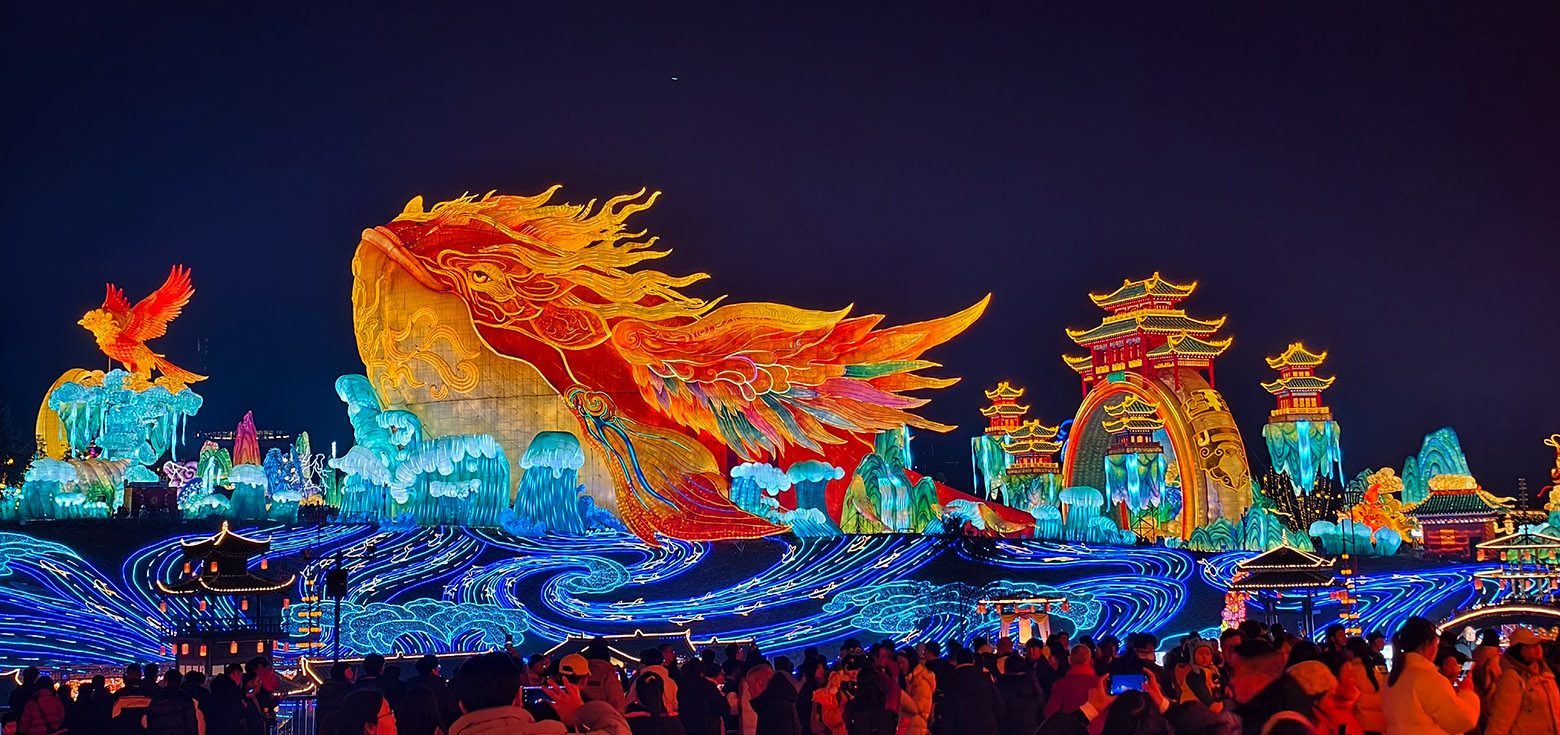
To complement this vibrant, warm, and highly social atmosphere, the Chinese have developed a colossal system of festival lighting:
The Scale: Hyperscale installations, exemplified by the steel-framed and silk-upholstered artistry of Zigong.
The Purpose: It is essentially humanity’s attempt to mirror the celestial moon with earthly fire.
The Visual Medium: These radiant structures function as a spiritual medium designed to conquer the darkness of the night, broadcasting the prosperity of the household and community.
Within this visual ecosystem, the craftsmanship, color saturation, and sheer physical scale of the lanterns dictate the architectural dominance of the festive space.
Korea's Chuseok: Ancestral Rituals and Silent Nights
When analyzing the deep-seated differences of the Mid-Autumn Festival vs Chuseok, one is immediately confronted with a radical inversion of social behavior.
On the night of the full moon, while Chinese cities enter a state of nocturnal euphoria with crowds flooding lantern fairs, Seoul plunges into a rare, ghost-town silence. The normally congested urban grid empties out as tens of millions of Koreans engage in a massive cross-country migration known as Gwiseong, racing to return to their ancestral hometowns before dawn.
The watershed dividing these two social phenomena lies in their focus:
China gathers the living under the cover of night.
Korea honors the departed under the light of day.
Chuseok is fundamentally a solemn national thanksgiving dedicated to ancestral remembrance. At dawn, families gather in traditional Hanbok to perform Charye, an intricate ritual offering newly harvested rice wine and fresh autumn fruits to ancestral spirits. This is followed by Beolcho, a mandatory journey into the hills to clear weeds from ancestral gravesites.
This profound Confucian order steers Chuseok aesthetics toward extreme minimalism and restraint. Koreans do not organize commercial or boisterous public lantern carnivals. Unlike China’s intense focus on the visual impact of traditional Mid-Autumn lanterns, Koreans treat this day as a time for internal reflection.
Their festive food reflects this rustic simplicity: families gather to handcraft Songpyeon, half-moon-shaped rice cakes steamed over a bed of fresh pine needles, infusing them with a sharp, natural fragrance. In this cross-cultural comparison, Korea proves that the autumn moon exists to serve as a spiritual beacon guiding the living back to their historical roots.

Vietnam's Tết Trung Thu: A Lantern Night for Children
A structural breakdown of Tết Trung Thu vs Mid-Autumn reveals that as the full moon shifts over the Red River Delta, a magical sociological inversion occurs, flipping the adult-dominated social order entirely on its head.
In Vietnam, this shared celestial milestone has been completely re-engineered into a nationwide festival where children are the absolute rulers of the night.
The origins of this unique cultural framework are deeply rooted in the agricultural cycles of a tropical monsoon climate:
The Agricultural Dilemma: Historically, the eighth lunar month marks the most labor-intensive bottleneck of the Vietnamese agricultural calendar, demanding non-stop harvesting and replanting.
The Collective Guilt: Because adults were entirely consumed by backbreaking field labor, young children faced prolonged periods of emotional neglect.
The Cultural Compensation: Consequently, once the harvest was safely stored, adults channelled their collective guilt, time, and material resources into an overwhelming display of affection for the younger generation.
This psychological compensation manifests as a street dynamic vastly different from China’s. On this night, public spaces are entirely requisitioned by waves of children.
The undisputed visual soul of the Vietnamese night is the rustic, vibrant Đèn Ông Sao—a five-pointed star lantern handcrafted from bamboo and colored cellophane. Clutching these glowing red and yellow stars, children march through neighborhoods accompanied by the thunderous rhythms of Múa Lân (lion dances).
Adults willingly retreat into the background as guardians and sponsors, using these raw, hand-lit shadows to build a magical domain completely insulated from the rigid rules of the adult world.

How One Moon Reflects Diverse Human Orders
The full moon is a uniform astronomical event, but within the global map of the celebration, it acts as a sociological lens reflecting diverse human systems and cultural healing mechanisms. The true brilliance of this cultural cluster lies not in a superficial adulation of the same celestial orb, but in how different nations deploy their visual arts to soothe the collective subconscious as winter approaches and darkness lengthens.
Whether it is China crowning secular reunion through the pinnacle of silk lantern craftsmanship, Korea reinforcing ancestral lineage through the quietude of Charye, or Vietnam offering a gentle promise to its future through a galaxy of star-shaped lanterns, each tradition ensures that the ancient light of the autumn sky shines with a distinct civilizational depth.