


Are Giant Christmas Lanterns "Killing" Small String Lights?
- ForestPainting
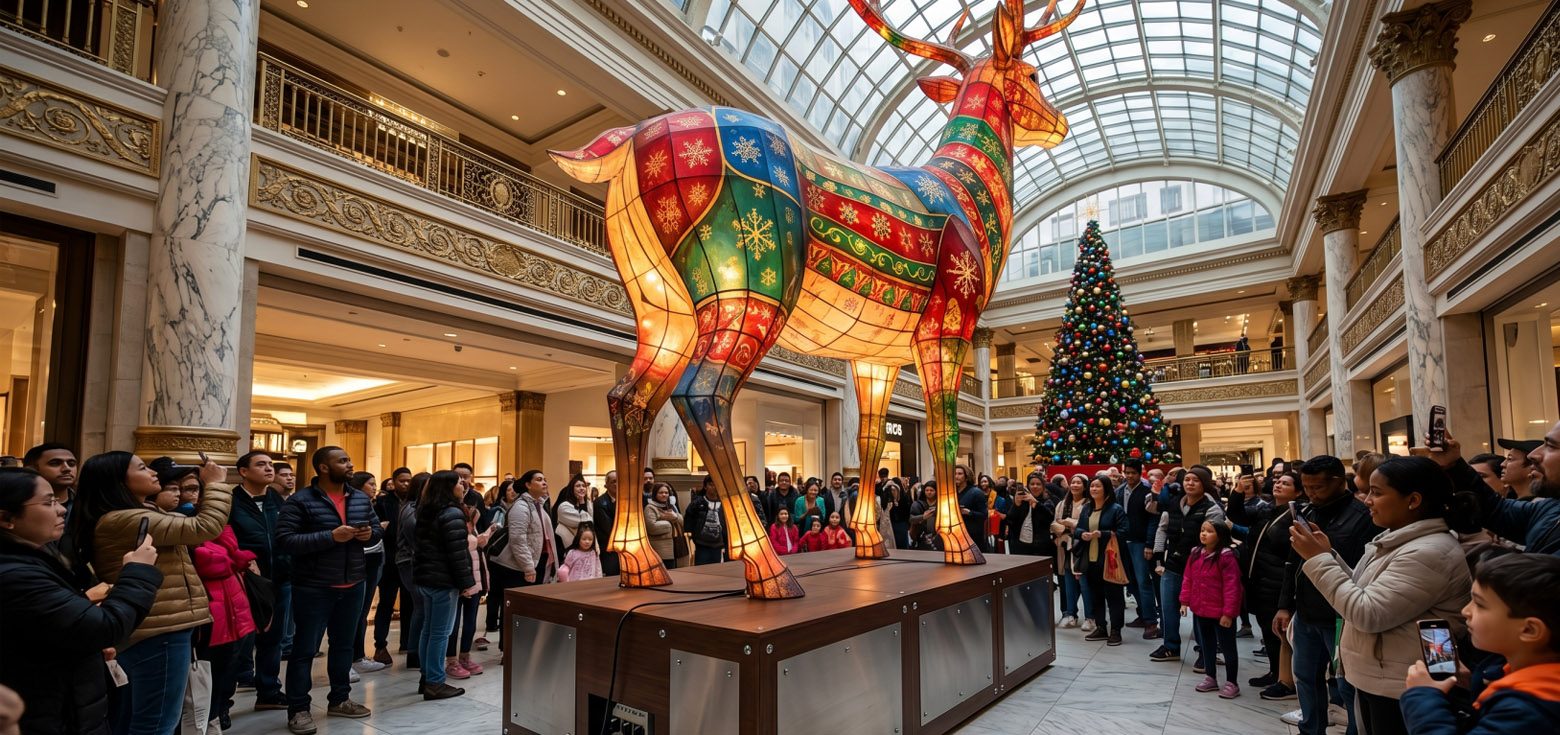
Every December, when you walk into a large shopping mall and look up at the awe-inspiring giant Christmas lanterns in the atrium—whether it’s a three-story glowing reindeer, a massive Santa Claus, or a brilliant castle made entirely of light and fabric—have you ever wondered: how are those ordinary small string lights hanging at the storefronts or along the eaves doing?
It sounds like an exaggerated joke. But if you have looked into the evolution of Christmas lighting decorations, you might notice a clear trend: large customized lanterns are multiplying, while traditional string lights seem to be taking a back seat in large commercial spaces. Some jokingly say that these giant structures are “killing” small string lights. Is this really the case?
The Rise of Custom Christmas Lanterns
Over the past decade, the frequency of custom Christmas lanterns appearing in commercial spaces has significantly increased. These illuminated sculptures are typically over 5 meters tall, with some reaching up to 20 meters. They require professional teams for structural design and manual crafting, and cost anywhere from tens of thousands to hundreds of thousands of dollars.
They are by no means standard assembly-line products; they are exclusively built based on the venue, theme, and brand DNA. As an important part of modern Christmas lighting decoration art, these giant illuminated installations are commonly found in shopping mall atriums, city squares, and theme park entrances. Their advantages are obvious: they serve as magnificent 3D sculptures during the day and deliver an overwhelming visual impact when lit up at night, easily becoming photo-op landmarks and highly shareable on social media.

The Current State of Small String Lights
Despite this, small string lights remain the most widely used type of lighting today. A single LED string light costs only a few dollars and can be bent, wrapped, and hung freely. For small shops, community streets, and office lobbies—where budgets are limited, spaces are small, and extreme visual shock isn’t required—string lights are still the most practical choice.
However, their procurement share in large commercial projects is indeed dropping. In a fiercely competitive commercial block, if one mall spends heavily on a stunning giant illuminated installation, the neighboring mall will naturally look underwhelming if it only uses a few ordinary string lights.
A Direct Comparison: Core Differences
Comparison Dimension | Giant Christmas Lanterns | Small String Lights |
Initial Investment | High (Tens to hundreds of thousands of USD) | Low (A few to hundreds of USD) |
Visual Effect | 3D, shocking, visible day and night | 2D, ambient, virtually invisible by day |
Customization | Brand new design annually, unique | Standardized products, uniform |
Lifespan | 6 to 12 months (outdoor natural aging) | Around 1 year (usually replaced annually) |
Viral Potential | Very strong (natural photo backdrop) | Weak (rarely photographed on purpose) |
Ideal Scenarios | Large commercial spaces, city landmarks | Small shops, communities, homes |
Brand Value | Can become a city symbol | None |
This table makes it clear: the two solutions are not even playing on the same field. They each have clearly defined boundaries of application.

How Should the Cost Be Calculated?
Many people assume that giant Christmas lanterns are expensive because they are a “one-time investment for multi-year use.” The commercial reality is quite different.
The outdoor lifespan of custom Christmas lanterns is typically only half a year to a year. Sun, rain, and temperature fluctuations naturally age the materials and steel frames. More importantly, consumers demand freshness every year—if they see the exact same design two years in a row, they will say, “It’s the same as last year, how boring.” Therefore, ambitious commercial clients customize entirely new themes and designs almost every year.
This means: giant lanterns are not “expensive once and used for years,” but rather “expensive every year, but worth it every year.”
The ledger for small string lights is completely different. They are cheap, but the annual purchasing and installation fees are essentially sunk costs. Over consecutive years, the total expenditure might not be lower than that of large displays. However, the absolute advantage of string lights is their low barrier to entry—no design team is needed, no ordering months in advance is required, and any small shop owner can hang them up themselves.
Why Are Malls Willing to Spend This Money Every Year?
The Christmas season is simply too crucial. For large shopping centers, sales from November to January often account for 20% to 30% of their annual revenue. During this decisive period, whoever can attract more foot traffic, keep people staying longer, and encourage them to post photos on social media wins.
Giant Christmas lanterns perfectly meet these three needs:
Attracting Foot Traffic: A breathtaking installation can grab the attention of pedestrians from two blocks away. In 2023, after a shopping center in London installed a giant Santa Claus, its foot traffic increased by 18% year-over-year.
Extending Dwell Time: Good installations have intricate details and designated photo spots. Data shows that in commercial spaces with giant illuminated installations, the average customer dwell time is 25% to 40% longer than in ordinary spaces.
Generating Viral Spread: Consumers spontaneously taking photos and posting them serves as free advertising with high trust.
More importantly, large-scale lantern projects can become city symbols. Consumers will say, “Let’s go to that mall to see the lanterns,” rather than “Let’s go to that mall to shop.” This kind of brand equity is something string lights can never provide.

It's Not "Killing," It's a "Division of Labor"
Back to the title’s question: Will giant Christmas lanterns kill small string lights? The answer is clearly no.
As the table above shows, the two serve completely different scenarios:
Giant Christmas lanterns: Large commercial spaces, aiming for shock value and viral spread, with new themes customized annually.
Small string lights: Small-to-medium scenarios, aiming for basic festive ambiance, low threshold, and flexible deployment.
In a large shopping center, placing a custom Christmas lantern in the atrium acts as the absolute visual focal point, while string lights are used around it for transition and harmony. One is responsible for the “Wow!”, and the other is responsible for the “Warmth.” The two are partners, not enemies.
The Bottom Line
The claim that “giant lanterns are killing small string lights” is more of a clickbait headline than a fact.
In large commercial spaces and urban public areas, the proportion of giant motif lanterns is rising; while in small-to-medium scenes, string lights remain the absolute main force. They are not replacements for each other; they have a division of labor.
If you are a mall or scenic area operator, the choice is not complicated: Want to create buzz, attract crowds, and build a city landmark? Giant Christmas lanterns are worth serious consideration. Have a limited budget, compact space, and only need basic ambiance? small string lights are enough.
There is no superiority or inferiority between the two. As for the “killing” concern—don’t worry. The vitality of string lights is much more resilient than we imagine. They are just gracefully yielding the spotlight to the large-scale lantern art that can create greater commercial shock.
After all, the core of Christmas is never the size of the lanterns, but the warm feeling ignited the moment you see the glow on a cold winter night.